Noticing a changing mole can feel alarming, especially in Texas where about 5,700 melanoma cases are forecast for 2025, and many of our neighbors in Katy rely on busy emergency centers for urgent care.
In this guide, we explain how to tell if a changing mole might be an emergency in Katy, how urgent care and dermatology fit together, and what you can generally expect when it comes to visits, timing, and costs, without making medical claims or giving diagnosis.
Key Takeaways
| Question | Short Answer |
|---|---|
| 1. When is a changing mole an emergency in Katy? | If a mole changes quickly, bleeds, hurts, or looks very different from others, many people seek same‑day evaluation. Our overview of warning signs starts at When to Get a Mole Checked in Katy. |
| 2. Should I go to the ER or a dermatologist in Katy? | For sudden or severe symptoms, residents often choose the ER. For non‑urgent but suspicious changes, a scheduled skin cancer screening, such as those described at Skin Cancer Screening in Katy, may be more appropriate. |
| 3. How often should I check my moles? | Many adults perform monthly self‑checks and consider annual professional exams. Our self‑check tips draw from the guidance at Melanoma Screening Near Cinco Ranch. |
| 4. What if I work outdoors in Katy? | Outdoor workers often need closer monitoring because of higher sun exposure. We expand on this using insights from Outdoor Workers Skin Cancer Screening in Katy. |
| 5. How much does a mole check or biopsy usually cost? | In Katy, skin cancer screening or a full body exam commonly runs about $100–$200, and a shave biopsy can start around $80 plus lab fees, based on data in Dermatology Costs Comparison: Katy vs Houston and Self‑Pay Dermatology Pricing in Katy. |
| 6. Can I find an affordable dermatologist without insurance? | Yes, several Katy practices publish transparent self‑pay pricing, with new visits often starting around $50–$75, as outlined at Affordable Dermatologist in Katy Cost Guide. |
1. What Counts as a “Changing Mole Emergency” in Katy?
When people in Katy search for “changing mole emergency,” they are usually worried about fast or dramatic changes that feel too serious to wait on. We see this especially in a state where Texas ranks third nationally for new melanoma cases, so awareness is high even if most changing moles turn out to be non‑urgent.
From our perspective, an “emergency” is less about a specific disease label and more about how sudden, severe, or worrisome the change feels to you. Rapid growth, new bleeding, pain, or a mole that looks very different from your others are common triggers for same‑day or same‑week evaluation.
Many residents start by comparing their mole to the ABCDE rule that dermatology groups often discuss for unusual spots. If multiple ABCDE features seem present or the change feels extreme, people often err on the side of urgent evaluation.
At the same time, some changes may be subtle, and not every new or odd‑looking mole requires emergency care, which is why scheduled skin cancer screening services in Katy play such an important role in keeping emergency rooms from becoming overloaded.
2. Katy’s Rising Demand for Emergency Care and Mole Concerns
Katy has grown rapidly in recent years, and more people mean more emergency visits for every kind of health issue, including worrisome skin changes. That increased demand is one reason local hospitals have been expanding emergency departments and observation units.
Residents who notice a changing mole often debate whether it can wait for a dermatology visit or needs immediate assessment. With so many people seeking care, shorter wait times and better triage are becoming crucial, especially when a patient is anxious about something that might be serious.
For context, one local hospital’s emergency department visits reportedly rose more than 50 percent in just a few years. That growth shows up in everything from longer wait rooms to more complex triage decisions about which symptoms are urgent and which can be redirected to outpatient care.
By understanding what local facilities can do and how dermatology fits into the picture, you can plan ahead so a changing mole does not always have to feel like a late‑night emergency.
3. Self‑Checking a Changing Mole: ABCDE and Beyond
We encourage patients to know their own skin, because you are the one who sees your moles every day. Monthly self‑checks, which are emphasized in mole‑check guides for Katy residents, help you notice changes early and reduce the chance that a new spot will feel like a complete surprise.
A widely used approach is the ABCDE rule for unusual moles: Asymmetry, Border irregularity, Color variation, Diameter and Evolving. Even without making any medical claims, this framework helps you describe what you see more clearly when you call a clinic or talk with a triage nurse.
Other details also matter when you are deciding if a changing mole feels urgent. Sudden itching, scabbing, bleeding, or a new raised bump on top of an old flat spot are examples of changes that many people bring up when they seek quick evaluation.
If you notice any of these shifts, it can help to take clear, date‑stamped photos so professionals in Katy can see the pattern of change over time, whether you end up in an ER, urgent care, or a dermatology office.
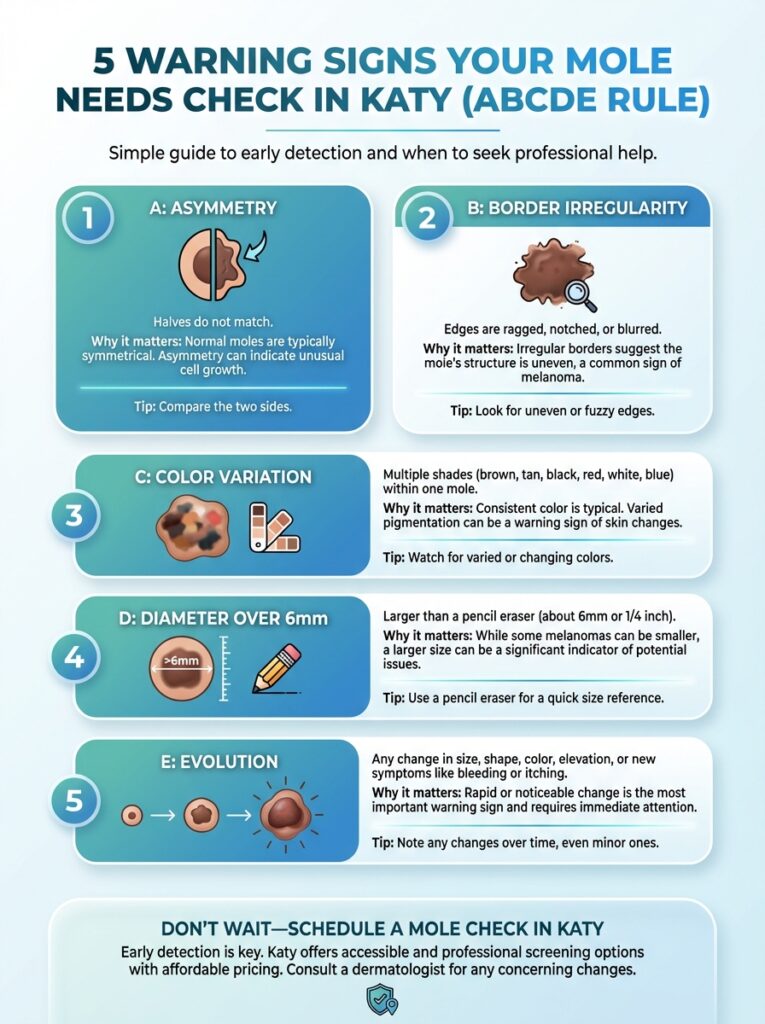
This infographic highlights the five warning signs that a mole may require medical evaluation in Katy, explained through the ABCDE rule. Use it to spot changes early and seek prompt care.
4. When a Changing Mole Feels Like an Emergency: ER vs Dermatology
If a mole changes overnight, starts bleeding out of nowhere, or comes with intense pain, many Katy residents understandably think “ER” first. Emergency teams are built to handle sudden, severe symptoms and to rule out immediate threats to your overall health.
For slower or more subtle changes, a scheduled dermatology visit, full body skin exam, or dedicated skin cancer screening clinic may provide a more focused evaluation. In Katy, full body exams are often described as head‑to‑toe checks where every mole is inspected and documented.
A simple way to think about it is to consider your comfort and safety in the short term. If you feel unsafe waiting or your symptoms are severe, emergency rooms or urgent care clinics remain an important resource, especially as local hospitals have expanded to shorten waiting times.
If you feel stable but concerned, calling a Katy dermatologist who offers same‑day or next‑day visits can sometimes save you an ER bill and give you more time with a skin specialist who sees changing moles every day.
Did You Know?
In 2024, the median time to see a provider in one Katy-area emergency room dropped from 47 minutes to 22 minutes, reflecting a regional push for faster triage when residents arrive with urgent concerns like sudden mole changes.
5. How Full Body Skin Exams in Katy Help Prevent “Emergency” Situations
One of the best ways to avoid late‑night mole panic is to make full body skin exams a routine part of your care. In Katy and nearby Cinco Ranch, melanoma screening services describe these exams as top‑to‑toe visual checks with documentation of moles for future comparison.
During these visits, clinicians may use tools such as dermoscopy or digital photography to track changes over time. That record can make a sudden change easier to interpret later, because there is a baseline image or description to compare against.
Many local guides recommend annual exams for average‑risk adults and more frequent checks for people with risk factors like fair skin, a history of many moles, or significant sun exposure. While we cannot promise specific outcomes, earlier evaluations usually mean more options and fewer surprises.
In practical terms, consistent exams can turn a potential “emergency” moment into a scheduled follow‑up, because both you and your clinician already know which moles are being watched.
6. Special Risk Groups in Katy: Outdoor Workers and High UV Exposure
Katy’s sunny climate and strong UV index create special concerns for people who work outdoors. Construction workers, landscapers, road crews, and delivery drivers can accumulate many hours of sun exposure each week, which is linked to changes in moles over time.
Guides focused on outdoor workers in Katy highlight annual or even more frequent skin cancer screening as a smart preventive step. That way, subtle mole changes have a better chance of being noticed and documented before they ever feel like emergencies.
Workplaces can also play a role by encouraging sun safety, such as hats, long sleeves, and regular use of sunscreen. Since about 86 percent of melanoma cases are attributed to UV exposure in national data, reducing that exposure is a key strategy.
For outdoor workers who suddenly notice a changing mole, having a regular relationship with a dermatologist in Katy can make it easier to get a prompt, non‑ER appointment to have it checked.
7. Understanding Common Diagnoses Linked to Changing Moles
While we do not make medical claims or diagnose conditions in this article, it helps to know the broad categories that clinicians in Katy consider when they see a changing mole. These can range from entirely harmless spots to conditions that require closer follow‑up or specific treatment plans.
For example, basal cell carcinoma is discussed in local guides as the most common type of skin cancer, often showing up as a pearly bump, a non‑healing sore, or a scaly patch. Some of these spots may be mistaken for moles at first glance, which is one reason a professional exam matters.
Melanoma resources in Katy describe that condition as one where pigment‑producing cells behave abnormally, sometimes in or near an existing mole. The ABCDE rule is commonly used to flag which spots may need more urgent attention out of caution, even if they ultimately prove non‑dangerous.
Many changing moles, however, turn out to be benign growths or age‑related changes that do not require aggressive treatment, which is why an in‑person evaluation is so important before you jump to conclusions.
Did You Know?
Texas is expected to see about 5,700 melanoma diagnoses in 2025, and it ranks third in the United States for new melanoma cases, which is why Katy residents are right to take changing moles seriously and seek timely evaluation.
8. What Mole Checks and Biopsies Typically Cost in Katy
Cost is one of the biggest reasons people delay getting a changing mole evaluated, so we rely on published Katy pricing data to give you a clearer picture. In local cost comparison guides, a skin cancer screening or full body skin exam is often listed in the range of $100–$200 for self‑pay patients.
If a clinician decides that a mole should be sampled, published self‑pay prices in Katy show shave biopsies starting around $80 plus roughly $40 for pathology fees, and punch biopsies around $100 plus $50 for lab work. Exact costs vary by clinic and insurance.
Some guides also reference excision procedures in the $100–$150 range for smaller lesions, with more complex work costing more. These figures help our patients budget and compare options before deciding where to go.
To make urgent mole checks more accessible, several Katy practices offer transparent self‑pay menus and sometimes payment plans, which can be especially helpful if you do not have insurance but want a changing mole examined without delay.
9. Navigating Care in Katy if You Do Not Have Insurance
A changing mole can feel even more stressful if you are uninsured or have a high‑deductible plan. Fortunately, several Katy dermatology guides emphasize that new patient self‑pay visits can start as low as about $50–$75, with follow‑ups around $50–$125 depending on the clinic.
Some practices offer bundled pricing or discounts when multiple procedures are done in the same visit, which can lower the overall cost of evaluating and managing a suspicious mole. Transparent fee schedules also make it easier for you to compare options before you book.
By calling ahead and asking specifically about mole checks, biopsies, and payment plans, you can often find a path that fits your budget and timeline. Our experience is that clinics in Katy are increasingly familiar with helping self‑pay patients navigate costs.
The key is to avoid postponing evaluation solely because of price uncertainty, especially if your mole is changing quickly or causing concern.
10. Practical Steps if You Notice a Changing Mole in Katy
When you first notice a changing mole, pause and gather information before you panic. Take clear photos from multiple angles, write down when you first saw the change, and note any symptoms such as itching, bleeding, or tenderness.
Next, decide what level of urgency you feel based on your symptoms. If you feel very unwell or the change is dramatic and accompanied by severe pain or rapid bleeding, emergency or urgent care may be the best immediate step for safety.
If you feel stable but worried, call a Katy dermatology office that offers skin cancer screening or same‑day visits. Share the details you wrote down so they can help you decide on the right timing and type of appointment.
Finally, commit to ongoing skin checks and regular professional exams once this urgent concern is addressed, so future changes are less likely to feel like sudden emergencies.
Conclusion
A changing mole in Katy can feel like an emergency, especially in a state with high melanoma numbers and rapidly growing use of emergency departments. By understanding self‑check basics, knowing when to consider ER vs dermatology, and having a rough idea of local costs, you can make calmer, more informed decisions when a new spot appears.
Our goal is to help you treat skin changes as something you monitor thoughtfully rather than something you ignore until the middle of the night. If a mole is worrying you, reach out to a qualified medical professional in Katy so you can get clarity and a personalized plan.